Why Planet Omar Beats the Burnout Book
The 2026 comfort shelf is overrated; the real emotional repair kit is a middle-grade comedy about accidental messes and making amends.
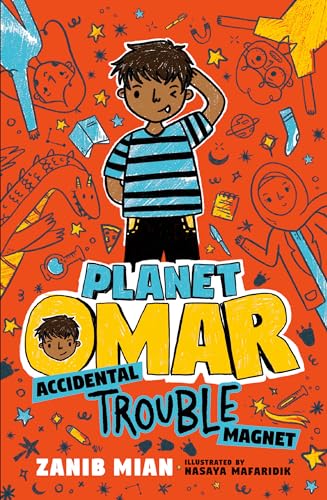
The adult burnout novel is the laziest answer to 2026’s emotional crisis, and Planet Omar: Accidental Trouble Magnet is the book actually doing the work. The consensus shelf wants you to believe that stress is solved by hibernation, cozy rituals, or a zombie apocalypse you can joke your way out of, and that is backwards. The most useful story on this list is not the one that lets you disappear; it is the one that makes you answer for what you broke, explain why it happened, and try again in public.
Best emotional-calibration books for burnout, identity, and reassurance
- Why My Year of Rest and Relaxation is the wrong burnout cure
- How The Last Kids on Earth turns apocalypse into teamwork
- Why Planet Omar: Accidental Trouble Magnet is the list’s most practical social repair kit
- What Glyph offers adult readers who want language to mean something again
The trend line reads like a mood board for people trying to manage uncertainty without losing themselves: playful low-stakes worlds for younger readers, burnout and survival for adults, moral pressure in YA and literary fiction. The common thread is not comfort, exactly. It is emotional regulation—how a story teaches you what to do with a nervous system that has been overloaded by news, work, identity, and expectation. The problem is that most of the hype is aimed at the wrong symptom. Readers are being sold pause buttons when what they need is a repair kit.
The consensus is already wrong: rest as a product, not a practice
 The overhyped answer is My Year of Rest and Relaxation. Ottessa Moshfegh’s adult literary novel is smart, spare, and genuinely funny, and its popularity is not accidental. It speaks to a reader who has been told to optimize sleep, curate boundaries, and treat attention as a finite resource. Cat, the protagonist, essentially takes that advice to its logical extreme: she isolates herself in a Brooklyn apartment, stops answering people, avoids the outside world, and spends a year in a kind of self-imposed hibernation. The premise is seductive because it looks like permission. You are not bad for being tired; you are just resting.
But the book’s power is also its problem. Moshfegh writes with such cool precision that the novel can be mistaken for a manual, when it is actually a warning. Cat does not learn a new relationship to work, guilt, or community. She suspends them. The apartment becomes a sealed system: no phone, no meaningful contact, no consequence except the slow pressure of the world trying to get in. That is not reassurance; it is a controlled collapse. The final scenes do not arrive as recovery. They arrive as a decision to re-enter, but the book has spent its best pages making withdrawal feel elegant. If you are looking for a book that teaches you how to repair a damaged life, this one mostly teaches you how to aestheticize the refusal to repair. It is a brilliant diagnosis of burnout, not a treatment.
The apocalypse is a joke: why The Last Kids on Earth works despite the stakes
 The Last Kids on Earth by Max Brallier, with art by Douglas Holgate, is the opposite of a quiet read, and that is exactly why it is useful. The premise is a middle-grade zombie apocalypse, but the emotional center is not survival for its own sake. It is the question of what a group of kids do when the rules disappear and they still have to decide who is in charge, who gets to be scared, and who has to make the hard choice. Zack and Quill, the central pair, give the series its engine: Zack is the loud, video-game-bias kid who turns panic into invention, while Quill is the practical one who keeps the group from becoming a disaster. Their friction is the real plot.
The series works because it keeps the stakes high enough to matter but low enough to survive. Zombies are funny, the apocalypse is a backdrop, and the characters are allowed to be ridiculous without the book becoming shallow. That matters for younger readers and for adults who are also tired of being treated as fragile. It says, effectively, that the world can be broken and you can still have a team, a plan, and a bad joke. If you want to understand why contained worlds feel so diagnostic, see The Labyrinth as Diagnostic: Why We Read Contained Worlds. Compared with the adult burnout novel, this is a more mature answer to stress: it does not promise that the world will become safe; it promises that you will not have to face it alone. The humor is not a substitute for consequence. It is the consequence made survivable.
The ignored repair kit: what Planet Omar: Accidental Trouble Magnet actually teaches
 Planet Omar: Accidental Trouble Magnet by Zanib Mian, with illustrations by Nasaya Mafaridik, is the book I would put in a reader’s hands first. It is a middle-grade comedy about a boy whose life is a series of accidental messes at home and school, but its real subject is social repair. Omar is not a prodigy, not a chosen one, not a hero in the traditional sense. He is a kid who is clumsy, anxious, and constantly trying to be normal while his family and school life keep throwing curveballs. The book’s set pieces—school play chaos, class-pet disasters, birthday-party mishaps—are funny, but they are also small laboratories for embarrassment, accountability, and making amends.
What makes it contrarian is that the most hyped books on this shelf often position the self as a problem to be managed, while this one positions the self as a problem to be solved with other people. Omar does not retreat into a sealed room. He goes back to the classroom, talks to his friends, admits mistakes, and tries to fix what he broke. The illustrations and short chapters make the emotional lessons feel immediate rather than preachy. For a young reader, that is a life skill. For an adult reader, it is a mirror: most of our stress is not caused by existential collapse but by small, repeated failures to communicate, apologize, or ask for help. Mian writes with a warmth that never condescends, and the book earns its reassurance by showing the work. It is not the laziest comfort read; it is the most practical one on the list.
The literary control valve: why Glyph matters more than it gets credit for
 If Planet Omar: Accidental Trouble Magnet is the practical answer, Glyph by Ali Smith is the literary one. Smith has long written about the small cracks in ordinary life—language, memory, politics, the things we assume we understand because they are already named. Glyph feels timely for the same reason: it is not a book that solves the reader’s anxiety by offering a bigger world; it is a book that asks what we are actually doing when we read a sign, a face, a message, or a moment. The novel’s compactness matters. It does not ask the reader to build a fantasy map or survive an apocalypse. It asks the reader to pay attention to how meaning changes when people stop speaking plainly.
This is the book for adult readers who are exhausted by emotional content that is too loud to sit with. Smith’s tone is precise, humane, and wry, and the novel’s structure rewards close reading rather than speed. It treats uncertainty as a normal condition, not a crisis to be cured. The central motif—a small mark that different characters read as warning, invitation, or accident—does the same work as the middle-grade messes, but at a slower, more linguistic level. In a list that includes burnout, apocalypse, and schoolyard chaos, Glyph is the instrument that calibrates the other books: it reminds us that stories are not just escapes but ways of learning to decode the world. If the burnout novel is a sedative and the zombie adventure is a shock absorber, Glyph is the diagnostic tool. It will not make the world feel easier, but it may make the reader less likely to mistake a symptom for a solution.
What the consensus gets right, and why it still misses
Credit where credit is due: the trend line is not stupid. Readers are correctly rejecting stories that treat suffering as decoration or growth as a slogan. The comfort-read market, the burnout novel, and the apocalypse adventure all respond to a real need: people want narrative that does not insult them with fake optimism. This is not just a list problem; it is a market problem, and our earlier argument in The Comfort Read Con: Why Instant Belonging Is a Lie already warned that instant belonging is often a sales pitch. The same logic applies here. The problem is that the market has confused relief with repair. A book can make you feel less alone without teaching you how to act. A book can make you feel understood without asking you to understand anyone else. That is where the hype goes astray. It sells emotional anesthesia as emotional intelligence.
Put the shelf together and the shape is clear. These books are not all trying to do the same thing. One offers a sealed room. One offers a team. One offers a classroom. One offers a way of reading the world more carefully. The best choice depends on what your nervous system is actually asking for: permission to stop, proof that you can still cooperate, a chance to laugh at your own mistakes, or a method for making sense of signals that no longer seem stable. The real skill is not picking the most comforting title. It is picking the one that matches the repair you are willing to do.
Editor's Verdict: The shelf’s true calibration dial
I rate Planet Omar: Accidental Trouble Magnet 9/10. It earns the score because the school-play set piece does more social-repair work in a dozen pages than the adult burnout novel does in its final chapter, and because the book consistently treats mistakes as things to be explained, not identities to be worn. It loses one point for middle-grade brevity: the emotional lessons sometimes resolve a little too neatly for the complicated adult reader who has outgrown the idea that a good apology fixes everything. Still, if you want a book that actually teaches you how to re-enter the world after a mess, this is the one to read.
FAQ
Which book should I choose if I am burnt out but still need to get through the day?
Start with [Planet Omar: Accidental Trouble Magnet](https://hardcover.app/books/planet-omar-accidental-trouble-magnet). It focuses on mistakes, accountability, and re-entering social life, making it a practical repair read rather than a withdrawal fantasy.
Is [My Year of Rest and Relaxation](https://hardcover.app/books/my-year-of-rest-and-relaxation) a comfort read?
Not really. It is a sharp diagnosis of burnout, but its protagonist mostly suspends life rather than repairing it, so it works better as a mirror than a manual.
Can middle-grade fiction be useful for adult readers?
Yes. Books like [The Last Kids on Earth](https://hardcover.app/books/the-last-kids-on-earth) and [Planet Omar: Accidental Trouble Magnet](https://hardcover.app/books/planet-omar-accidental-trouble-magnet) package emotional regulation—teamwork, humor, apology, repair—in a form that is easy to absorb and emotionally direct.